
Kids' Brazilian Jiu-JitsuKids' BJJ: a parents' guide
What Brazilian Jiu-Jitsu teaches children, how our classes keep them safe, and what to expect from the first class to their first belt.
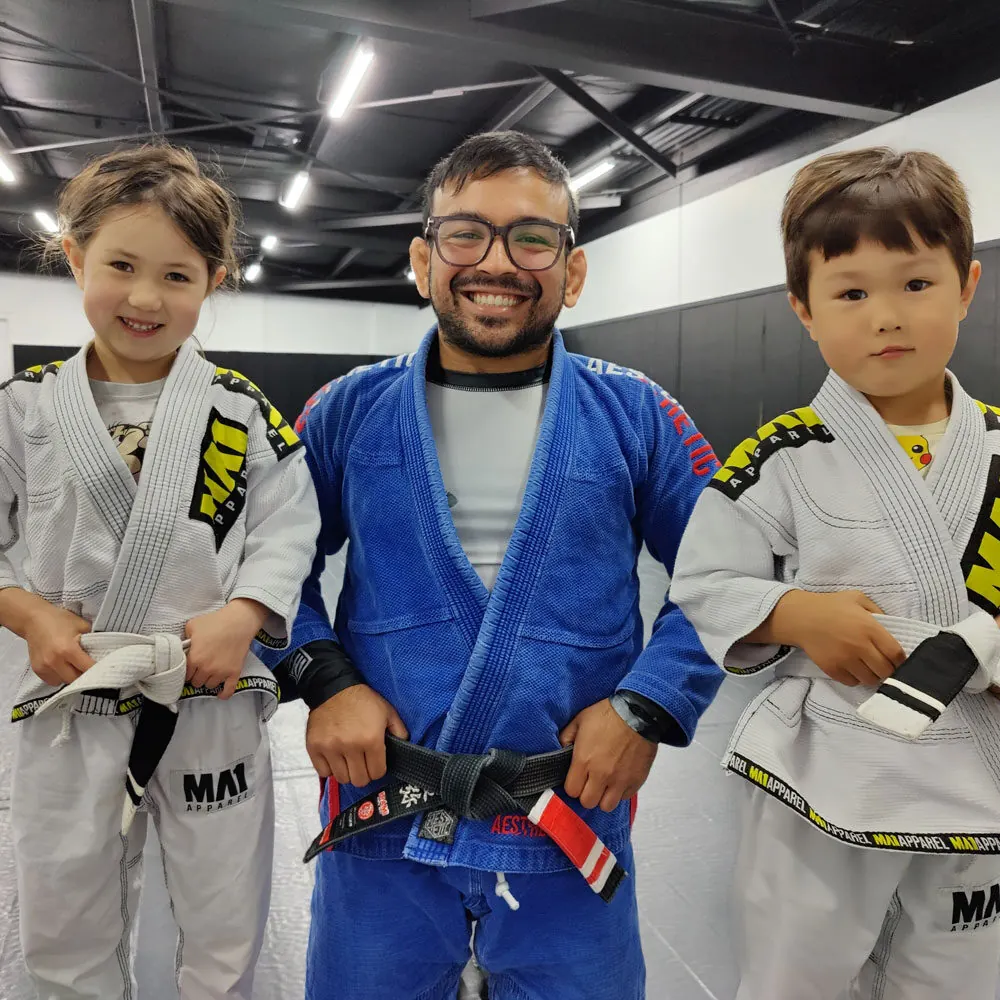
Why BJJ is a great martial art for kids
Brazilian Jiu-Jitsu (BJJ) is a grappling art. Instead of punching and kicking, children learn to control a partner with balance, leverage and good positioning, so a smaller child can handle a bigger one without anyone getting hurt.
- Self-defence without striking. Kids learn to stay calm, escape holds and control a situation, which is a more appropriate answer to bullying than learning to hit.
- Confidence that carries over. Working through a hard position on the mat, then solving it, builds the kind of resilience that shows up at school and at home.
- Fitness through play. Classes are full-body: strength, flexibility, coordination and endurance, learned through games and drills rather than laps of the room.
- Problem-solving. BJJ is often called physical chess. Children learn to think a move ahead and adapt when something doesn't work.
- Friends and community. Kids train with the same group each week and become part of a team.
What age can my child start?
Children can start from age 4. Our regular kids' program at Absolute MMA St Kilda is for ages 5–15, and classes are grouped by age so each child trains with others at a similar stage:
- 4–5-year-olds: a weekly Saturday morning No-Gi class built around movement, coordination and play.
- 5–7s and 7–11s: separate afternoon classes on Monday, Wednesday and Thursday.
- Over-11s (up to 15): their own afternoon class, with more technical detail and more live training.
Younger children learn through games and age-appropriate activities. As they get older and more skilled, coaches gradually introduce more complex techniques, live sparring and submissions. From 16, students move up to the adult BJJ classes. Teenagers who want to add striking can also join Teen MMA at Collingwood (ages 13–17).
Full class times are on the St Kilda timetable.
What happens in a kids' BJJ class?
Each class starts with a warm-up and movement games, then moves to technique. Coaches demonstrate a skill, kids practise it with a partner, and coaches go around correcting and encouraging. Classes include supervised live training, called rolling, and an end-of-class line-up where coaches share news and upcoming events.
Over time your child will learn standing techniques drawn from wrestling and judo, and ground techniques such as pinning, controlling, sweeping and, once they're old enough, submissions. Just as importantly, they learn to listen, take turns, respect their partners and keep trying when something is hard.
Is BJJ safe for children?
Safety is the first priority in every class. There is no punching or kicking in BJJ. When children practise defending against strikes, it's in controlled self-defence drills with a coach and there's no impact.
- Supervised sparring. Rolling is closely watched by coaches, and partners are matched by age, size and skill.
- Technique first. Kids are taught to perform techniques properly and to look after their training partners. Tapping out to stop a technique is taught from day one.
- Qualified coaches. Our kids' coaches are experienced in teaching children, hold Working With Children Checks and are trained in first aid and CPR.
- Clear rules. Behaviour expectations are explained and applied consistently, with kindness and respect.
If you ever have a concern, talk to the coaching team. We encourage open communication with both kids and parents.
Gi or No-Gi?
We run both. In Gi classes children wear a traditional uniform, similar to a judo or karate uniform, and can grip their partner's jacket and pants. No-Gi classes are trained in shorts and a t-shirt or rash guard, without grips on clothing, so a different range of techniques comes into play.
At St Kilda, Monday and Thursday classes are Gi, Wednesday is No-Gi, and Saturday has both. Most kids end up enjoying both. If you're not sure where to start, a No-Gi class needs no special uniform. Read more in our guide to Gi vs No-Gi BJJ.
What should my child wear and bring?
- No-Gi classes: shorts and a t-shirt or rash guard. Training shorts without zips, metal buttons or pockets are best.
- Gi classes: a gi (kimono). Gis are available from reception.
- A mouthguard is optional but recommended for live training.
- A water bottle, and thongs or slides for walking to and from the mat.
Before the first class, a parent or guardian needs to complete the parental consent form.
Hygiene and mat rules
- No shoes on the mats, ever, and shoes on whenever you step off them.
- Wash training clothes, including the belt, after every session.
- Keep fingernails and toenails trimmed.
- If your child is unwell, please keep them home so everyone stays healthy.
Belts, stripes and gradings
Gradings are a celebration of progress, not a test. There's no pass or fail. They are usually held once per school term.
At each grading, coaches look at your child's technique and knowledge, but also their attendance, behaviour and respect for coaches, teammates and their uniform. Children can earn up to three stripes per grading. Around 12 stripes usually makes a child eligible for the next belt, which works out to about a year of consistent training and good behaviour.
Gradings are included in membership. There's no extra fee for gradings or belts.
BJJ is a long game. Reaching black belt typically takes around 10 years of consistent training, and the minimum age for a black belt is 19. Children work through their own kids' belt system on the way.
How parents can help
- Make attendance a habit. Regular, consistent training is what builds skill and confidence.
- Practise at home, safely. Drilling a technique with a parent or sibling helps, but set a rule that grappling at home only happens in a designated space and in suitable clothes. Remember the size difference if you join in.
- Come to competitions and events. They're a great way for kids to challenge themselves, and they love having you there.
- Praise effort, not just results. BJJ is challenging. Celebrating persistence matters more than celebrating wins.
- Leave the coaching to the coaches. You're very welcome to watch from the viewing area, but please don't coach from the sidelines. It can confuse kids and pull their attention away from the class.
Common questions
Will my child be punched or kicked?
No. BJJ is a grappling art, so there is no striking. Children practise defending against strikes only in controlled drills with a coach, with no impact.
What happens when my child turns 16?
From 16, students can train in the adult BJJ classes. Many kids who have trained with us for years make the move with a strong foundation already in place.
Do kids spar in BJJ?
Yes. Supervised live training, called rolling, is part of most classes. There's no striking, coaches watch closely, and partners are matched by age, size and skill.
Can I watch my child's class?
Yes. Parents are welcome to watch from the viewing area. We just ask that you don't sit on the mats or coach from the sidelines.
Can I take photos during class?
To protect every family's privacy, please don't take photos or videos during class. You're welcome to take photos of your own child after class, as long as no other children are in the shot, and our coaches are happy to pose for a photo.
How is discipline handled?
Coaches set clear expectations and apply them consistently, firmly but always with kindness and respect. Depending on the situation, that might be a verbal reminder, a short time-out or, rarely, being asked to leave the class.
Is there a family discount?
Yes. Families with two or more people training at Absolute MMA receive a family discount. Ask the team at reception for details.
What happens during school holidays?
We run a school holiday program for kids. Ask the team at reception for this term's dates and times.
Do I need to book classes in the app?
No. Just check in at reception before each class so we know who's on the mat.
Can students from other academies train with you?
Yes. We welcome students from other academies. Cross-training is good for development, and we value respect between schools.
How will I hear about events and gradings?
We send official updates by email, so keep your email address up to date with us. Upcoming events are also announced at the end-of-class line-up.
Start training